
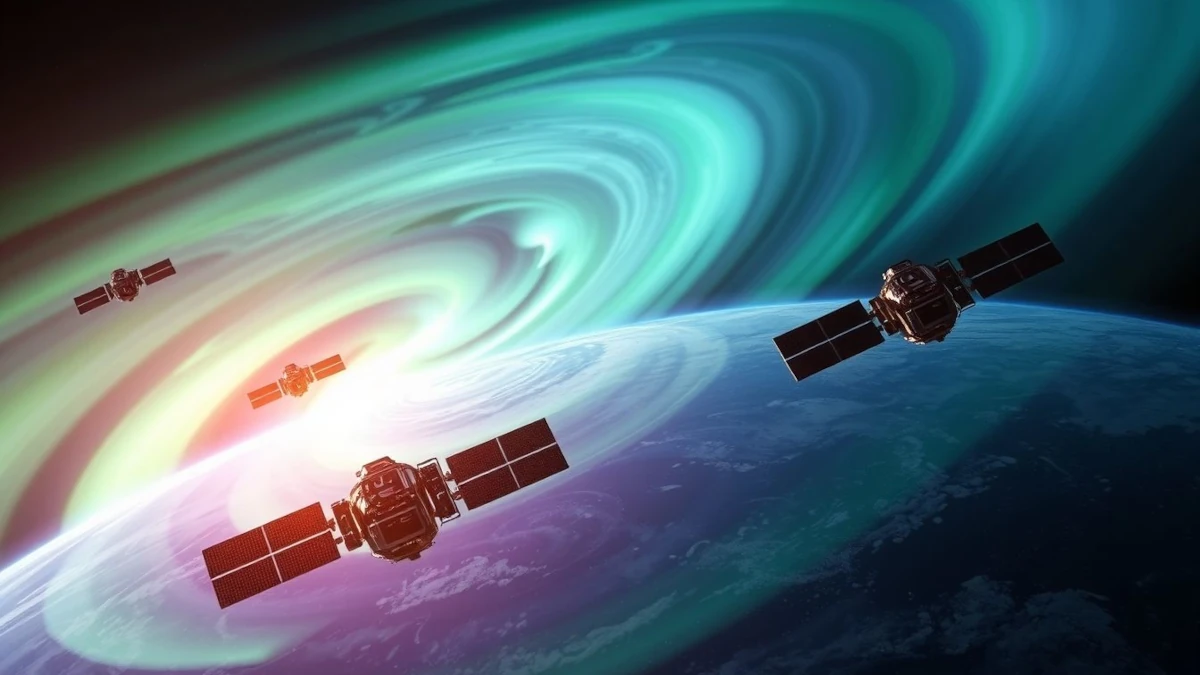
Space weather can have disruptive and damaging results. Solar flares, coronal mass ejections, and high-energy radiation from the sun can have an negative effects on satellites, GPS signals and power grids on Earth resulting in hazardous geomagnetic storms:
Most people are familiar with weather on Earth, but space weather can be just as disruptive. Solar storms release bursts of charged particles that travel through space at high speeds. When these storms reach Earth, they can cause geomagnetic disturbances that disrupt navigation systems, impact satellite operations, damage satellites, and even induce currents in power grids, leading to blackouts.
There are two organizations protecting US vital infrastructure from the effects of space weather. The National Environmental Satellite, Data, and Information Service (NESDIS) provides critical satellite data, and NOAA’s Space Weather Prediction Center (SWPC) detects and provides forecasts for space weather events. Both organizations protect satellites and critical infrastructure in the US.
NOAA has a vital role in space weather predictions through a combined network of satellites, ground-based observations, and advanced prediction models. NOAA’s Space Weather Prediction Center (SWPC) provides space weather alerts, watches and warnings and is the nation’s official source for such alerts. NOAA’s satellite and information service, NESDIS, provides crucial observational data that helps predict SWPC’s forecasts.
Three NOAA satellite programs monitor space weather:
SWFO-L1 (Space Weather Follow On at Lagrange Point 1 (L1): Scheduled for launch to the Lagrange Point 1 (L1) in 2025, SWFO-L1 will improve NOAA’s ability to detect solar storms before they reach Earth, providing earlier warnings for industries dependent on accurate space weather forecasts.
GOES Satellites: The Geostationary Operational Environmental Satellites (GOES) continuously monitor the sun’s activity, providing real-time imagery of solar flares and coronal mass ejections (CMEs). They also determine space weather effects, like particle beams and magnetic fields, in Earth’s upper atmosphere to help protect communication, navigation and power systems.
DSCOVR: (Deep Space Climate Observatory): Orbiting at Lagrange Point (L1) since 2015, DSCOVR detects solar wind in real time, providing early warnings for geomagnetic storms disruptive to power grids, satellites, and GPS systems.
The Carrington Event of 1859, one of the most extreme space weather events on record, was a solar event that resulted in telegraph systems to spark and fail. Today, a solar storm as enormous as Carrington Event, could possibly disable communication networks, affect the power grid and cost the global economy trillions of dollars.
Three studies regarding the damaging effects of space weather were addressed:
A 2017 NOAA-Commissioned Report highlighted the widespread economic and social impact of space weather disruptions.
A 2020 Congressional Budget Office (CBO) Report warned that strengthening the North American electric grid against space weather threats is a national security priority.
In 2020, NESDIS commissioned Eastern Research Group, Inc. to conduct an Economic Benefit Analysis assessing the value of NOAA’s space weather forecasting services.
Space weather can disrupt aircraft navigation and communication systems. High latitudes create issues when radiation storms due to heightened radiation exposure to passengers and crew. NOAA forecasts recommend route and altitude adjustments that lessen the impact on communication and navigation systems while reducing radiation exposure.
When a geomagnetic storm is oncoming, satellite operators can switch their spacecraft to a safer area to avert possible damage to their spacecraft or maintain satellite altitude:
Improved space weather forecasts are particularly essential for satellites in Low-Earth Orbit (LEO), ensuring longer operational lifespans, reducing risks of premature re-entry, and lowering risk of collision.
GPS signals are greatly affected by solar storms. This is troublesome since navigation systems used by shipping, the space industry, military operations, drones and autonomous vehicles, precision agriculture and oil and gas prospecting and drilling are heavily reliant on GPS technology.
Widespread outages, equipment failure, and long-term disruptions to power distribution can result from geomagnetic storms which cause power surges in the electric power grid.
NOAA is continuing its efforts to detect and minimize the effects of future solar storms by increasing collaborations with U.S. agencies and academic and private sector partners.
NOAA’s Space Weather Next program and the upcoming launch of the Space Weather Follow-On (SWFO) satellite at Lagrange Point 1, will further bolster its arsenal of space weather mitigating systems ensuring government and commercial space operations can withstand the challenges of space weather events.